


Beyond the Bowl: Part 6 — The Raw Difference: Nutrients That Support a Trainable Brain
Beyond the Bowl: Part 6 — The Raw Difference: Nutrients That Support a Trainable Brain
We are back with Part 6 of our series with behavioral neuroscientist Dr. Pepe Hernandez. Last week, we looked at where highly processed diets can fall short. This week, we flip to the solution side: the specific whole-food nutrients in a complete raw diet that help build a brain ready to learn.
The Raw Difference: Nutrients That Support a Trainable Brain
By Dr. Pepe Hernandez, PhD, CPDT-KA
This is where the conversation moves from problem to solution. A complete, carefully formulated raw diet may offer something many heavily processed diets struggle to preserve: a nutrient-dense, whole-food matrix rich in high-quality protein, essential fatty acids, vitamins, minerals, moisture, and food-based cofactors that support normal nervous-system function.
That does not mean raw food trains the dog. It does not. It means that a dog's brain has to be biologically prepared to benefit from training. A dog who is nutritionally under-supported, digestively uncomfortable, or metabolically strained may have a harder time focusing, recovering from arousal, retaining new information, or showing up consistently from one session to the next.
"A complete raw diet is not magic. It is infrastructure."
— Dr. Pepe Hernandez, PhD, CPDT-KA
Omega-3 Fatty Acids: Cell Membranes, Development, and Learning
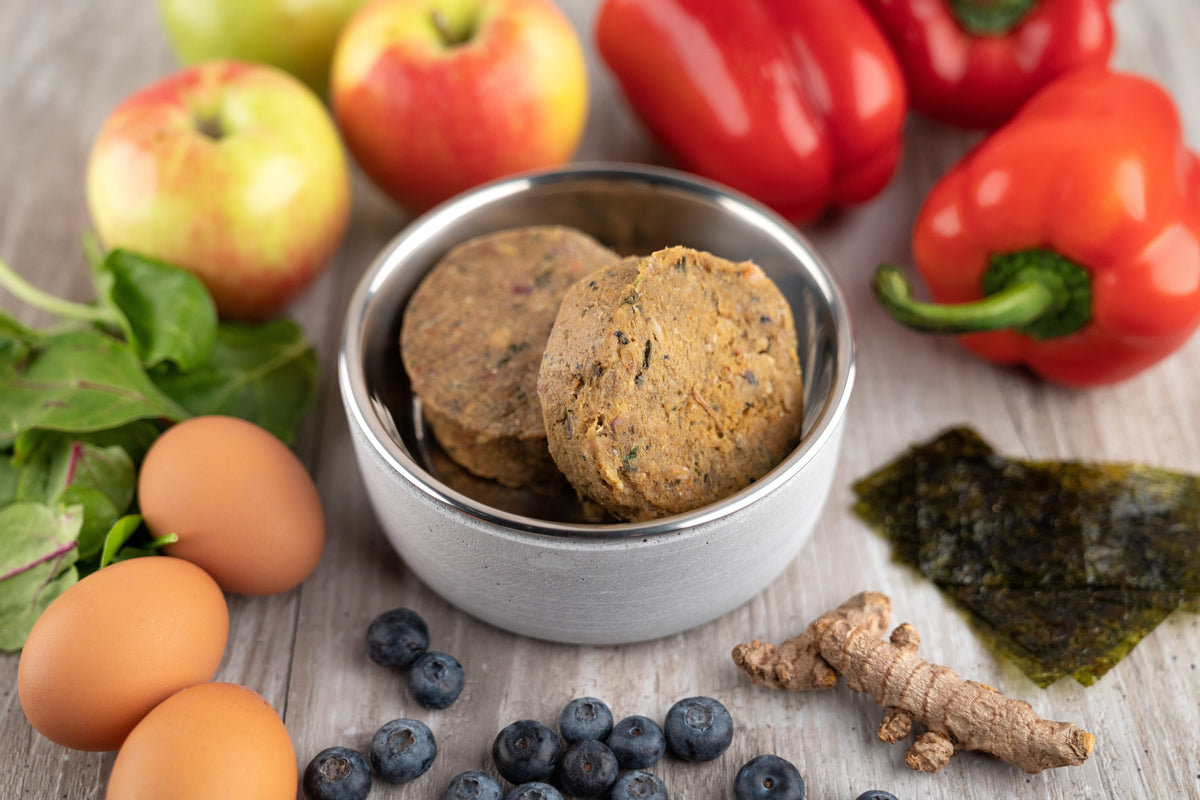
Omega-3 fatty acids, especially DHA, are incorporated into neuronal cell membranes and help support the cell signaling systems involved in brain development and learning. In puppy studies, diets fortified with DHA-rich fish oil have been associated with improved performance on several learning-related tasks, including reversal learning, visual discrimination, and early maze performance. [1] Wild-caught salmon provides naturally occurring DHA and EPA in a whole-food form, making it a valuable brain-supportive ingredient in a complete diet.
Grass-Fed Beef and Organ Meats: Amino Acids and B-Vitamin Cofactors
Grass-fed beef and organ meats — including liver, kidney, heart, and spleen — provide high-quality animal protein, tryptophan, and B-complex vitamins such as B6, B12, and riboflavin, all of which help support normal nervous-system metabolism. [2,3] Tryptophan is the dietary precursor for serotonin, while B vitamins act as cofactors in enzymatic pathways that help convert nutrients into chemical messengers involved in regulation, attention, and learning. [4]
Whole Eggs: Choline, Attention, and Memory
Whole eggs, especially the yolk, provide a rich whole-food source of choline — an essential nutrient involved in cell-membrane function, neurological development, and the synthesis of acetylcholine. [5,6] Acetylcholine is one of the key neurotransmitters involved in attention, learning, and memory encoding, [7] which makes choline part of the nutritional foundation that supports a dog's ability to retain and build on what they learn in training.
Wild Blueberries: Antioxidants and Cognitive Resilience
Wild blueberries are rich in anthocyanins, plant-based antioxidants studied for their anti-inflammatory and antioxidant effects in pathways relevant to brain aging. [8] In dogs, antioxidant-enriched diets have been shown to improve performance on certain learning tasks in aged Beagles, especially tasks affected by age-related cognitive decline. [9,10] In a complete diet, wild blueberries are best understood not as a training shortcut, but as a concentrated source of polyphenols that may help support long-term cognitive resilience.
Turmeric and Curcumin: Inflammation and Motivation Pathways
Curcumin, the primary active compound in turmeric, has been studied for antioxidant and anti-inflammatory effects, including pathways relevant to neuroinflammation. [11,12] Chronic inflammation can interfere with dopamine-related reward and motivation circuits, making effortful learning harder. [13] In training terms, a dog who is physically comfortable, less inflamed, and better regulated is more available for attention, reinforcement, and learning.
(We covered magnesium's role in stress regulation back in Part 4 — still very much part of this whole-food picture.)

Next Week: Part 7 — the gut-brain connection, and the story of the dog who started it all.
References
- Zicker, S.C., Jewell, D.E., Yamka, R.M., & Milgram, N.W. (2012). Evaluation of cognitive learning, memory, psychomotor, immunologic, and retinal functions in healthy puppies fed foods fortified with DHA-rich fish oil. Journal of the American Veterinary Medical Association, 241(5), 583–594. DOI
- National Research Council. (2006). Nutrient requirements of dogs and cats. National Academies Press. Link
- Fuerniss, H.F., et al. (2024). Nutrient analysis of raw United States beef offal items. Animals, 14(15), 2198. DOI
- Kautz, A., et al. (2024). Dietary intake of nutrients involved in serotonin and melatonin synthesis and metabolism. Nutrients, 16(9), 1255. DOI
- DiBella, M., et al. (2020). Choline intake as supplement or as a component of eggs increases plasma choline and reduces interleukin-6 without modifying plasma cholesterol in participants with metabolic syndrome. Nutrients, 12(10), 3120. DOI
- Derbyshire, E., & Obeid, R. (2020). Choline, neurological development and brain function: A systematic review focusing on the first 1000 days. Nutrients, 12(6), 1731. DOI
- Hasselmo, M.E. (2006). The role of acetylcholine in learning and memory. Current Opinion in Neurobiology, 16(6), 710–715. DOI
- Kalt, W., Cassidy, A., Howard, L.R., Krikorian, R., Stull, A.J., Tremblay, F., & Zamora-Ros, R. (2020). Recent research on the health benefits of blueberries and their anthocyanins. Advances in Nutrition, 11(2), 224–236. DOI
- Cotman, C.W., Head, E., Muggenburg, B.A., Zicker, S., & Milgram, N.W. (2002). Brain aging in the canine: A diet enriched in antioxidants reduces cognitive dysfunction. Neurobiology of Aging, 23(5), 809–818. DOI
- Siwak, C.T., Tapp, P.D., Zicker, S.C., et al. (2005). Chronic antioxidant and mitochondrial cofactor administration improves discrimination learning in aged but not young dogs. Progress in Neuro-Psychopharmacology and Biological Psychiatry, 29(3), 461–469. DOI
- Kępińska-Pacelik, J., & Biel, W. (2023). Turmeric and curcumin — Health-promoting properties in dogs. Animals, 13(17), 2772. DOI
- Zhou, B., Lin, T., Li, J., & Wu, F. (2025). Anti-inflammatory effect of curcumin on neurological disorders. Frontiers in Pharmacology. Link
- Felger, J.C., & Treadway, M.T. (2017). Inflammation effects on motivation and motor activity: Role of dopamine. Neuropsychopharmacology, 42(1), 216–241. DOI